Heatset and sheet-fed offset print supplier. Welcome to Elanders Poland!
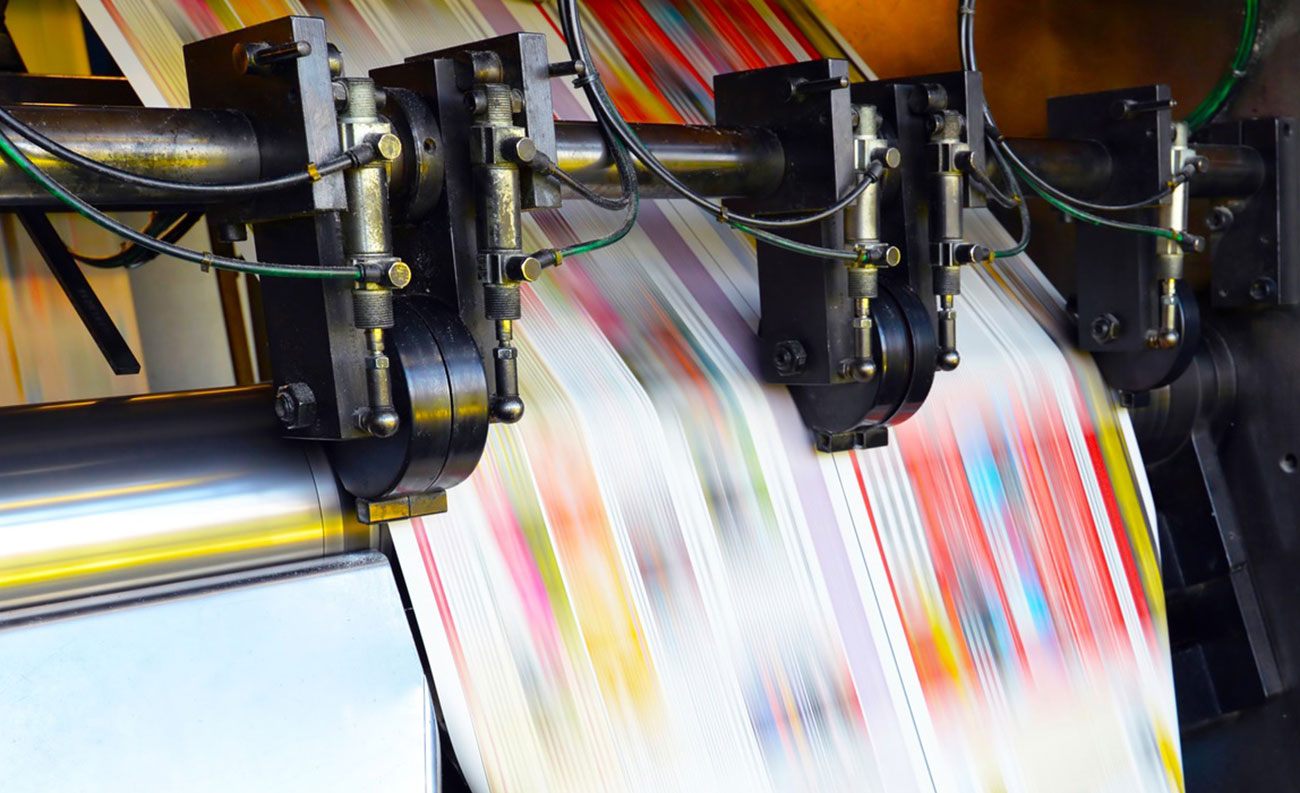
Elanders Poland specializes in web offset heatset print. Our color offset heatset presses print at a speed of up to 55,000 sections per hour. This means we can produce high volumes of magazines and catalogues with excellent quality very quickly.
With offset printing with web-fed heatset presses:
- We offer competitive pricing per copy with medium-to-large orders
- We offer double-sided printing in a single run
- Already folded sections are obtained – time and cost saving process
- No drying time is needed between prints, saving you time
- You benefit from high-quality prints from high-speed machinery (up to 55,000 sections/1h)
- You may receive a finished product, ready for distribution (brochures, supermarket flyers)
At Elanders Poland, we use two types of web offset printing:
- Heatset printing, for high-quality prints (e.g. magazines and catalogues). In this process, the ink is fixed by absorption into paper and evaporation at high temperatures using printing presses with 4+4 colors. Our production is equipped with Rotoman N and Rotoman 55 printing presses.
- Coldset printing, for black and white (1+1 colour) prints like A5-sized user manuals. In this process, ink is fixed by absorption into paper.
Possible sections achieved in web-fed presses (formats and number of pages):
- A4 size with sections of 4, 8, 12, and 16 pages with gluing in spine option
- A5 size with sections of 16 and 32 pages
- A6 size with sections of 32 and 64 pages
- Non-standard sizes e.g. 290×290 mm (12 pages), 180×297 mm (20 pages), 150×297 mm (24 pages), 120×297 mm (28 pages), 193×193 mm (24 pages), 190×297 mm (18 pages), 180×193 mm (30 pages), 150×193 (36 pages), 120×193 mm (42 pages), and many more!
The paper used for web printing
- available in a range of weights from 42–130 g/m2
- available coated or uncoated, depending on your needs
- available with FSC® certificate upon request
- available in different sizes of reels
- waiting time 4–6 weeks or from our stock
Is web printing right for you and your project? Consider the following:
- Do you need to print catalogues, brochures or magazines in more than 15,000 copies?
- Are you working with standard A4/A5/A6 sizes? If not, are you open to reformatting?
- Is the weight of the paper needed for your project between 42–130 g/m2?
- Do the inside pages of your project require 4+4 colour?
If you answered “yes” to any of these questions, your project is most likely suited for web printing technology. Contact one of our specialists today about your project for personalized recommendations regarding the best technology options available to you.
Two characteristics of web offset printing to be aware of:
The shorter cover effect occurs when two technologies are used for a project (e.g., sheet-fed printing for the cover and web heatset printing for the inside pages). During web heatset printing, the paper shrinks slightly due to the high temperatures in the heating unit. After binding, the paper takes in moisture from the air, regains volume, and expands, resulting in a roughly 1 mm size increase. This effect is common and is almost invisible to the end user.
Ideally, the fibres that make up the paper in a book or magazine will be aligned vertically (from top to bottom). For sheet-fed printing, it is possible to buy paper suitable for a project’s final size in sheets with the correct fibre alignment (short or long grain). In a reel of paper, fibres are uniformly arranged in one direction. Therefore, some printing formats will achieve the correct vertical fibre alignment, while others will have a transverse fibre alignment. Paper behaves differently when its fibres are transverse. Transverse fibres are almost invisible when used with saddle stitching or hard covers, but they are more visible when perfect binding is used. At Elanders Poland, we will inform you if your selected format must be produced with a transverse fibre.
Web offset printing versus sheet-fed offset printing
The final cost of a project printed via offset printing depends on the type of offset printing used. Most of the several thousand printing houses in Poland use sheet-fed machines; only a few can boast about offset web presses, as these machines are very expensive and very large, requiring an immense amount of space in a production hall.
Several distinctive features set heatset web offset machines apart from sheet-fed machines. A major advantage is their printing speed, which is 4–5 times faster than the speed of sheet-fed printers. Additionally, automatic folding systems are built directly into the machines, turning printed sheets into finished products. This eliminates the need for drying and additional folding processes, which are essential for projects that have been sheet-fed printed. A sheet of paper has a specific size, so it must be folded to obtain a specific number of pages or format. While the A4 size is the standard format used in web offset printing, it is possible to obtain various final formats depending on the technical capabilities of a given machine. Finally, large quantities of paper on a reel are cheaper than the same quantities of sheet paper. Because of these factors, web offset printing is time-saving and economical, resulting in much lower unit prices for customers.
Offset printing uses technology that allows for the best colour reproduction. Sheet-fed allows the use of additional Pantone colours, such as gold and silver, web-fed offers CMYK reproduction. Thus, exclusive magazines, catalogues, albums, and other promotional materials of the highest quality can be printed to reflect a company’s desired image.
When using offset printing, it is necessary to keep the minimum input in mind. Sheet-fed offset printing works best when at least 1,000 sheets of one layout are printed. On the other hand, web offset printing presses require at least 15,000–20,000 copies to be profitable.
When a project is ready for printing, it is necessary to decide what type of paper will be used. Sheet paper ranges from 60–350 g/m2. Higher paper weights are used in the printing of books with lower inputs, albums, folders, special catalogues, periodicals, and leaflets. Web offset printing is normally done on a roll of paper weighing 42–130 g/m2, but it ultimately depends on a printing house’s technical capabilities and type of folding. Both web offset and sheet-fed printing can be done on coated or uncoated paper with full range of quality of the paper including the best one (woodfree coated called art paper).
Are you interested in web offset printing? Our well-trained and experienced printers, 24 hour production, ISO certificates and attractive prices guarantee your successful cooperation with us.
Individual cookie settings
Here you can specify in detail which services you wish to allow. Individual services can be enabled or disabled within each category.
You can choose whether or not you wish to "accept only essential cookies," "accept all cookies" or if you wish to "save individual cookie settings" by selecting specific cookies in the accordion menu.
Granting consent to the use of non-essential cookies is voluntary. You can also change your settings at a later time via the "Cookie settings" button located in the page footer. Full details can be found in our Privacy Policy.
We use Google Analytics to obtain continuous analysis and statistical evaluation of the website in order to improve the website and the user experience. This involves user behaviour data being transmitted to Google LLC and the sites visited, time spent on the page and interactions being processed. This data is then used by Google for its own purposes to build a profile and to link with other usage data.
By accepting the cookie associated with Google services, you also grant consent for your data to be processed in the USA by Google, in accordance with Article 49(1a) GDPR. The USA is classified by the European Court of Justice as a country whose data protection level fails to meet EU standards.
In particular, there is a risk of your data being processed by US authorities for control and monitoring purposes, potentially without even the opportunity to appeal. If you click on "accept only essential cookies," the above transmission shall not take place.